Mpi ( message passing interface )


Table of Contents

  1. What is MPI?
  2. Environment Management Routines
  3. Point to Point Communication Routines
  4. Collective Communication Routines
  5. Derived Data Types
  6. Group and Communicator Management Routines
  7. Virtual Topologies
  8. A Brief Word on MPI-2
  9. LLNL Specific Information and Recommendations
  10. References and More Information
  11. Appendix A: MPI-1 Routine Index
  12. Exercise


What is MPI?


An Interface Specification: MPI Logo

  • M P I = Message Passing Interface

  • MPI is a specification for the developers and users of message passing libraries. By itself, it is NOT a library - but rather the specification of what such a library should be.

  • Simply stated, the goal of the Message Passing Interface is to provide a widely used standard for writing message passing programs. The interface attempts to be
    • practical
    • portable
    • efficient
    • flexible

  • Interface specifications have been defined for C/C++ and Fortran programs.

The Message Passing Interface Standard (MPI) is a message passing library standard based on the consensus of the MPI Forum, which has over 40 participating organizations, including vendors, researchers, software library developers, and users. The goal of the Message Passing Interface is to establish a portable, efficient, and flexible standard for message passing that will be widely used for writing message passing programs. As such, MPI is the first standardized, vendor independent, message passing library. The advantages of developing message passing software using MPI closely match the design goals of portability, efficiency, and flexibility. MPI is not an IEEE or ISO standard, but has in fact, become the "industry standard" for writing message passing programs on HPC platforms.

The goal of this tutorial is to teach those unfamiliar with MPI how to develop and run parallel programs according to the MPI standard. The primary topics that are presented focus on those which are the most useful for new MPI programmers. The tutorial begins with an introduction, background, and basic information for getting started with MPI. This is followed by a detailed look at the MPI routines that are most useful for new MPI programmers, including MPI Environment Management, Point-to-Point Communications, and Collective Communications routines. Numerous examples in both C and Fortran are provided, as well as a lab exercise.

The tutorial materials also include more advanced topics such as Derived Data Types, Group and Communicator Management Routines, and Virtual Topologies. However, these are not actually presented during the lecture, but are meant to serve as "further reading" for those who are interested.

Level/Prerequisites: Ideal for those who are new to parallel programming with MPI. A basic understanding of parallel programming in C or Fortran is assumed. For those who are unfamiliar with Parallel Programming in general, the material covered in https://computing.llnl.gov/tutorials/parallel_comp/ would be helpful.


History and Evolution:

  • MPI resulted from the efforts of numerous individuals and groups over the course of a 2 year period between 1992 and 1994. Some history:

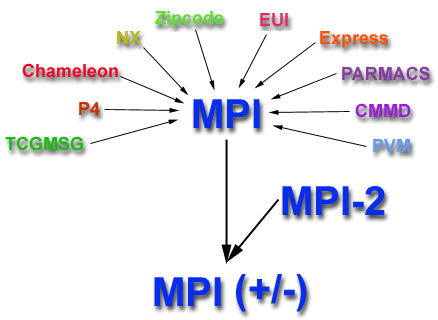
  • 1980s - early 1990s: Distributed memory, parallel computing develops, as do a number of incompatible software tools for writing such programs - usually with tradeoffs between portability, performance, functionality and price. Recognition of the need for a standard arose. MPI Evolution
  • April, 1992: Workshop on Standards for Message Passing in a Distributed Memory Environment, sponsored by the Center for Research on Parallel Computing, Williamsburg, Virginia. The basic features essential to a standard message passing interface were discussed, and a working group established to continue the standardization process. Preliminary draft proposal developed subsequently.

  • November 1992: - Working group meets in Minneapolis. MPI draft proposal (MPI1) from ORNL presented. Group adopts procedures and organization to form the MPI Forum. MPIF eventually comprised of about 175 individuals from 40 organizations including parallel computer vendors, software writers, academia and application scientists.

  • November 1993: Supercomputing 93 conference - draft MPI standard presented.

  • MPI-2 picked up where the first MPI specification left off, and addressed topics which go beyond the first MPI specification. The original MPI then became known as MPI-1. MPI-2 is briefly covered later. Was finalized in 1996.

  • Today, MPI implementations are a combination of MPI-1 and MPI-2. A few implementations include the full functionality of both.

Reasons for Using MPI:

  • Standardization - MPI is the only message passing library which can be considered a standard. It is supported on virtually all HPC platforms. Practically, it has replaced all previous message passing libraries.

  • Portability - There is no need to modify your source code when you port your application to a different platform that supports (and is compliant with) the MPI standard.

  • Performance Opportunities - Vendor implementations should be able to exploit native hardware features to optimize performance. For more information about MPI performance see the MPI Performance Topics - http://www.llnl.gov/computing/tutorials/mpi_performance tutorial.

  • Functionality - Over 115 routines are defined.

  • Availability - A variety of implementations are available, both vendor and public domain.

Programming Model:

  • MPI lends itself to most (if not all) distributed memory parallel programming models. In addition, MPI is commonly used to implement (behind the scenes) some shared memory models, such as Data Parallel, on distributed memory architectures.

  • Hardware platforms:
    • Distributed Memory: Originally, MPI was targeted for distributed memory systems.
    • Shared Memory: As shared memory systems became more popular, particularly SMP / NUMA architectures, MPI implementations for these platforms appeared.
    • Hybrid: MPI is now used on just about any common parallel architecture including massively parallel machines, SMP clusters, workstation clusters and heterogeneous networks.

  • All parallelism is explicit: the programmer is responsible for correctly identifying parallelism and implementing parallel algorithms using MPI constructs.

  • The number of tasks dedicated to run a parallel program is static. New tasks can not be dynamically spawned during run time. (MPI-2 addresses this issue).


Getting Started


Header File:

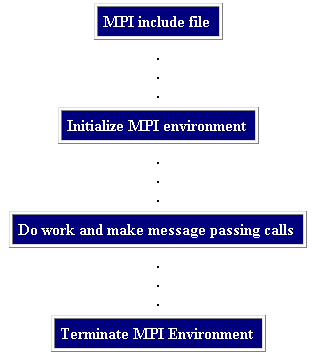
  • Required for all programs/routines which make MPI library calls.

    #include "mpi.h"
    C include file Fortran include file
    include 'mpif.h'

Format of MPI Calls:

    Format: Example: Error code:
    C Binding
    rc = MPI_Xxxxx(parameter, ... )
    rc = MPI_Bsend(&buf,count,type,dest,tag,comm)
    Returned as "rc". MPI_SUCCESS if successful

    Format: Example: Error code:
    Fortran Binding
    CALL MPI_XXXXX(parameter,..., ierr)
    call mpi_xxxxx(parameter,..., ierr)
    CALL MPI_BSEND(buf,count,type,dest,tag,comm,ierr)
    Returned as "ierr" parameter. MPI_SUCCESS if successful

  • C names are case sensitive; Fortran names are not.

General MPI Program Structure:

    General MPI Program Structure

Communicators and Groups:

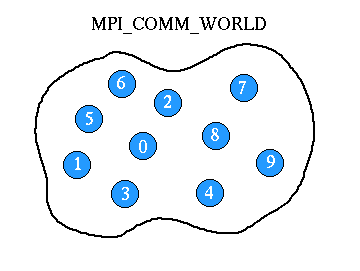
  • MPI uses objects called communicators and groups to define which collection of processes may communicate with each other. Most MPI routines require you to specify a communicator as an argument.

  • Communicators and groups will be covered in more detail later. For now, simply use MPI_COMM_WORLD whenever a communicator is required - it is the predefined communicator that includes all of your MPI processes.
 

Rank:

  • Within a communicator, every process has its own unique, integer identifier assigned by the system when the process initializes. A rank is sometimes also called a "process ID". Ranks are contiguous and begin at zero.

  • Used by the programmer to specify the source and destination of messages. Often used conditionally by the application to control program execution (if rank=0 do this / if rank=1 do that).

Environment Management Routines


MPI environment management routines are used for an assortment of purposes, such as initializing and terminating the MPI environment, querying the environment and identity, etc. Most of the commonly used ones are described below.

MPI_Init

Initializes the MPI execution environment. This function must be called in every MPI program, must be called before any other MPI functions and must be called only once in an MPI program. For C programs, MPI_Init may be used to pass the command line arguments to all processes, although this is not required by the standard and is implementation dependent.

MPI_Init (&argc,&argv)
MPI_INIT (ierr)

MPI_Comm_size

Determines the number of processes in the group associated with a communicator. Generally used within the communicator MPI_COMM_WORLD to determine the number of processes being used by your application.

MPI_Comm_size (comm,&size)
MPI_COMM_SIZE (comm,size,ierr)

MPI_Comm_rank

Determines the rank of the calling process within the communicator. Initially, each process will be assigned a unique integer rank between 0 and number of processors - 1 within the communicator MPI_COMM_WORLD. This rank is often referred to as a task ID. If a process becomes associated with other communicators, it will have a unique rank within each of these as well.

MPI_Comm_rank (comm,&rank)
MPI_COMM_RANK (comm,rank,ierr)

MPI_Abort

Terminates all MPI processes associated with the communicator. In most MPI implementations it terminates ALL processes regardless of the communicator specified.

MPI_Abort (comm,errorcode)
MPI_ABORT (comm,errorcode,ierr)

MPI_Get_processor_name

Returns the processor name. Also returns the length of the name. The buffer for "name" must be at least MPI_MAX_PROCESSOR_NAME characters in size. What is returned into "name" is implementation dependent - may not be the same as the output of the "hostname" or "host" shell commands.

MPI_Get_processor_name (&name,&resultlength)
MPI_GET_PROCESSOR_NAME (name,resultlength,ierr)

MPI_Initialized

Indicates whether MPI_Init has been called - returns flag as either logical true (1) or false(0). MPI requires that MPI_Init be called once and only once by each process. This may pose a problem for modules that want to use MPI and are prepared to call MPI_Init if necessary. MPI_Initialized solves this problem.

MPI_Initialized (&flag)
MPI_INITIALIZED (flag,ierr)

MPI_Wtime

Returns an elapsed wall clock time in seconds (double precision) on the calling processor.

MPI_Wtime ()
MPI_WTIME ()

MPI_Wtick

Returns the resolution in seconds (double precision) of MPI_Wtime.

MPI_Wtick ()
MPI_WTICK ()

MPI_Finalize

Terminates the MPI execution environment. This function should be the last MPI routine called in every MPI program - no other MPI routines may be called after it.

MPI_Finalize ()
MPI_FINALIZE (ierr)

Examples: Environment Management Routines

    C Language - Environment Management Routines Example
    
       #include "mpi.h"
       #include <stdio.h>
    
       int main(argc,argv)
       int argc;
       char *argv[]; {
       int  numtasks, rank, rc; 
    
       rc = MPI_Init(&argc,&argv);
       if (rc != MPI_SUCCESS) {
         printf ("Error starting MPI program. Terminating.\n");
         MPI_Abort(MPI_COMM_WORLD, rc);
         }
    
       MPI_Comm_size(MPI_COMM_WORLD,&numtasks);
       MPI_Comm_rank(MPI_COMM_WORLD,&rank);
       printf ("Number of tasks= %d My rank= %d\n", numtasks,rank);
    
       /*******  do some work *******/
    
       MPI_Finalize();
       }
    

    Fortran - Environment Management Routines Example
    
       program simple
       include 'mpif.h'
    
       integer numtasks, rank, ierr, rc
    
       call MPI_INIT(ierr)
       if (ierr .ne. MPI_SUCCESS) then
          print *,'Error starting MPI program. Terminating.'
          call MPI_ABORT(MPI_COMM_WORLD, rc, ierr)
       end if
    
       call MPI_COMM_RANK(MPI_COMM_WORLD, rank, ierr)
       call MPI_COMM_SIZE(MPI_COMM_WORLD, numtasks, ierr)
       print *, 'Number of tasks=',numtasks,' My rank=',rank
    
    C ****** do some work ******
    
       call MPI_FINALIZE(ierr)
    
       end
    

Point to Point Communication Routines

General Concepts

Types of Point-to-Point Operations:
  • MPI point-to-point operations typically involve message passing between two, and only two, different MPI tasks. One task is performing a send operation and the other task is performing a matching receive operation.

  • There are different types of send and receive routines used for different purposes. For example:
    • Synchronous send
    • Blocking send / blocking receive
    • Non-blocking send / non-blocking receive
    • Buffered send
    • Combined send/receive
    • "Ready" send

  • Any type of send routine can be paired with any type of receive routine.

  • MPI also provides several routines associated with send - receive operations, such as those used to wait for a message's arrival or probe to find out if a message has arrived.
Buffering:
  • In a perfect world, every send operation would be perfectly synchronized with its matching receive. This is rarely the case. Somehow or other, the MPI implementation must be able to deal with storing data when the two tasks are out of sync.

  • Consider the following two cases:
    • A send operation occurs 5 seconds before the receive is ready - where is the message while the receive is pending?
    • Multiple sends arrive at the same receiving task which can only accept one send at a time - what happens to the messages that are "backing up"?

  • The MPI implementation (not the MPI standard) decides what happens to data in these types of cases. Typically, a system buffer area is reserved to hold data in transit. For example:
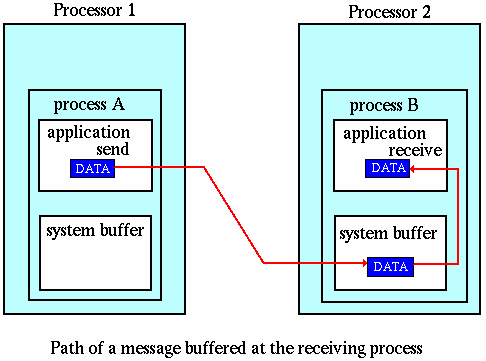
    System buffering example


  • System buffer space is:
    • Opaque to the programmer and managed entirely by the MPI library
    • A finite resource that can be easy to exhaust
    • Often mysterious and not well documented
    • Able to exist on the sending side, the receiving side, or both
    • Something that may improve program performance because it allows send - receive operations to be asynchronous.

  • User managed address space (i.e. your program variables) is called the application buffer. MPI also provides for a user managed send buffer.
Blocking vs. Non-blocking:
  • Most of the MPI point-to-point routines can be used in either blocking or non-blocking mode.

  • Blocking:
    • A blocking send routine will only "return" after it is safe to modify the application buffer (your send data) for reuse. Safe means that modifications will not affect the data intended for the receive task. Safe does not imply that the data was actually received - it may very well be sitting in a system buffer.
    • A blocking send can be synchronous which means there is handshaking occurring with the receive task to confirm a safe send.
    • A blocking send can be asynchronous if a system buffer is used to hold the data for eventual delivery to the receive.
    • A blocking receive only "returns" after the data has arrived and is ready for use by the program.

  • Non-blocking:
    • Non-blocking send and receive routines behave similarly - they will return almost immediately. They do not wait for any communication events to complete, such as message copying from user memory to system buffer space or the actual arrival of message.
    • Non-blocking operations simply "request" the MPI library to perform the operation when it is able. The user can not predict when that will happen.
    • It is unsafe to modify the application buffer (your variable space) until you know for a fact the requested non-blocking operation was actually performed by the library. There are "wait" routines used to do this.
    • Non-blocking communications are primarily used to overlap computation with communication and exploit possible performance gains.

Order and Fairness:

  • Order:
    • MPI guarantees that messages will not overtake each other.
    • If a sender sends two messages (Message 1 and Message 2) in succession to the same destination, and both match the same receive, the receive operation will receive Message 1 before Message 2.
    • If a receiver posts two receives (Receive 1 and Receive 2), in succession, and both are looking for the same message, Receive 1 will receive the message before Receive 2.
    • Order rules do not apply if there are multiple threads participating in the communication operations.

  • Fairness:
    • MPI does not guarantee fairness - it's up to the programmer to prevent "operation starvation".
    • Example: task 0 sends a message to task 2. However, task 1 sends a competing message that matches task 2's receive. Only one of the sends will complete.


Point to Point Communication Routines

MPI Message Passing Routine Arguments

MPI point-to-point communication routines generally have an argument list that takes one of the following formats:

    Blocking sends Non-blocking sends Blocking receive Non-blocking receive
    MPI_Send(buffer,count,type,dest,tag,comm)
    MPI_Isend(buffer,count,type,dest,tag,comm,request)
    MPI_Recv(buffer,count,type,source,tag,comm,status)
    MPI_Irecv(buffer,count,type,source,tag,comm,request)
Buffer

Program (application) address space that references the data that is to be sent or received. In most cases, this is simply the variable name that is be sent/received. For C programs, this argument is passed by reference and usually must be prepended with an ampersand: &var1

Data Count

Indicates the number of data elements of a particular type to be sent.

Data Type

For reasons of portability, MPI predefines its elementary data types. The table below lists those required by the standard.

MPI_CHAR MPI_CHARACTER MPI_SHORT MPI_INT MPI_INTEGER MPI_LONG MPI_UNSIGNED_CHAR MPI_UNSIGNED_SHORT MPI_UNSIGNED MPI_UNSIGNED_LONG MPI_FLOAT MPI_REAL MPI_DOUBLE MPI_DOUBLE_PRECISION MPI_LONG_DOUBLE MPI_COMPLEX MPI_DOUBLE_COMPLEX MPI_LOGICAL MPI_BYTE MPI_BYTE MPI_PACKED MPI_PACKED
C Data Types Fortran Data Types
signed char character(1)
signed short int
signed int integer
signed long int
unsigned char
unsigned short int
unsigned int
unsigned long int
float real
double double precision
long double
complex
double complex
logical
8 binary digits 8 binary digits
data packed or unpacked with MPI_Pack()/ MPI_Unpack data packed or unpacked with MPI_Pack()/ MPI_Unpack

Notes:

  • Programmers may also create their own data types (see Derived Data Types).
  • MPI_BYTE and MPI_PACKED do not correspond to standard C or Fortran types.
  • The MPI standard includes the following optional data types:
    • C: MPI_LONG_LONG_INT
    • Fortran: MPI_INTEGER1, MPI_INTEGER2, MPI_INTEGER4, MPI_REAL2, MPI_REAL4, MPI_REAL8
  • Some implementations may include additional elementary data types (MPI_LOGICAL2, MPI_COMPLEX32, etc.). Check the MPI header file.

Destination

An argument to send routines that indicates the process where a message should be delivered. Specified as the rank of the receiving process.

Source

An argument to receive routines that indicates the originating process of the message. Specified as the rank of the sending process. This may be set to the wild card MPI_ANY_SOURCE to receive a message from any task.

Tag

Arbitrary non-negative integer assigned by the programmer to uniquely identify a message. Send and receive operations should match message tags. For a receive operation, the wild card MPI_ANY_TAG can be used to receive any message regardless of its tag. The MPI standard guarantees that integers 0-32767 can be used as tags, but most implementations allow a much larger range than this.

Communicator

Indicates the communication context, or set of processes for which the source or destination fields are valid. Unless the programmer is explicitly creating new communicators, the predefined communicator MPI_COMM_WORLD is usually used.

Status

For a receive operation, indicates the source of the message and the tag of the message. In C, this argument is a pointer to a predefined structure MPI_Status (ex. stat.MPI_SOURCE stat.MPI_TAG). In Fortran, it is an integer array of size MPI_STATUS_SIZE (ex. stat(MPI_SOURCE) stat(MPI_TAG)). Additionally, the actual number of bytes received are obtainable from Status via the MPI_Get_count routine.

Request

Used by non-blocking send and receive operations. Since non-blocking operations may return before the requested system buffer space is obtained, the system issues a unique "request number". The programmer uses this system assigned "handle" later (in a WAIT type routine) to determine completion of the non-blocking operation. In C, this argument is a pointer to a predefined structure MPI_Request. In Fortran, it is an integer.


Point to Point Communication Routines

Blocking Message Passing Routines

The more commonly used MPI blocking message passing routines are described below.

MPI_Send

Basic blocking send operation. Routine returns only after the application buffer in the sending task is free for reuse. Note that this routine may be implemented differently on different systems. The MPI standard permits the use of a system buffer but does not require it. Some implementations may actually use a synchronous send (discussed below) to implement the basic blocking send.

MPI_Send (&buf,count,datatype,dest,tag,comm)
MPI_SEND (buf,count,datatype,dest,tag,comm,ierr)

MPI_Recv

Receive a message and block until the requested data is available in the application buffer in the receiving task.

MPI_Recv (&buf,count,datatype,source,tag,comm,&status)
MPI_RECV (buf,count,datatype,source,tag,comm,status,ierr)

MPI_Ssend

Synchronous blocking send: Send a message and block until the application buffer in the sending task is free for reuse and the destination process has started to receive the message.

MPI_Ssend (&buf,count,datatype,dest,tag,comm)
MPI_SSEND (buf,count,datatype,dest,tag,comm,ierr)

MPI_Bsend

Buffered blocking send: permits the programmer to allocate the required amount of buffer space into which data can be copied until it is delivered. Insulates against the problems associated with insufficient system buffer space. Routine returns after the data has been copied from application buffer space to the allocated send buffer. Must be used with the MPI_Buffer_attach routine.

MPI_Bsend (&buf,count,datatype,dest,tag,comm)
MPI_BSEND (buf,count,datatype,dest,tag,comm,ierr)

MPI_Buffer_attach
MPI_Buffer_detach

Used by programmer to allocate/deallocate message buffer space to be used by the MPI_Bsend routine. The size argument is specified in actual data bytes - not a count of data elements. Only one buffer can be attached to a process at a time. Note that the IBM implementation uses MPI_BSEND_OVERHEAD bytes of the allocated buffer for overhead.

MPI_Buffer_attach (&buffer,size)
MPI_Buffer_detach (&buffer,size)
MPI_BUFFER_ATTACH (buffer,size,ierr)
MPI_BUFFER_DETACH (buffer,size,ierr)

MPI_Rsend

Blocking ready send. Should only be used if the programmer is certain that the matching receive has already been posted.

MPI_Rsend (&buf,count,datatype,dest,tag,comm)
MPI_RSEND (buf,count,datatype,dest,tag,comm,ierr)

MPI_Sendrecv

Send a message and post a receive before blocking. Will block until the sending application buffer is free for reuse and until the receiving application buffer contains the received message.

MPI_Sendrecv (&sendbuf,sendcount,sendtype,dest,sendtag,
...... &recvbuf,recvcount,recvtype,source,recvtag,
...... comm,&status)
MPI_SENDRECV (sendbuf,sendcount,sendtype,dest,sendtag,
...... recvbuf,recvcount,recvtype,source,recvtag,
...... comm,status,ierr)

MPI_Wait
MPI_Waitany
MPI_Waitall
MPI_Waitsome

MPI_Wait blocks until a specified non-blocking send or receive operation has completed. For multiple non-blocking operations, the programmer can specify any, all or some completions.

MPI_Wait (&request,&status)
MPI_Waitany (count,&array_of_requests,&index,&status)
MPI_Waitall (count,&array_of_requests,&array_of_statuses)
MPI_Waitsome (incount,&array_of_requests,&outcount,
...... &array_of_offsets, &array_of_statuses)
MPI_WAIT (request,status,ierr)
MPI_WAITANY (count,array_of_requests,index,status,ierr)
MPI_WAITALL (count,array_of_requests,array_of_statuses,
...... ierr)
MPI_WAITSOME (incount,array_of_requests,outcount,
...... array_of_offsets, array_of_statuses,ierr)

MPI_Probe

Performs a blocking test for a message. The "wildcards" MPI_ANY_SOURCE and MPI_ANY_TAG may be used to test for a message from any source or with any tag. For the C routine, the actual source and tag will be returned in the status structure as status.MPI_SOURCE and status.MPI_TAG. For the Fortran routine, they will be returned in the integer array status(MPI_SOURCE) and status(MPI_TAG).

MPI_Probe (source,tag,comm,&status)
MPI_PROBE (source,tag,comm,status,ierr)


Examples: Blocking Message Passing Routines

    Task 0 pings task 1 and awaits return ping

    C Language - Blocking Message Passing Routines Example
    
    #include "mpi.h"
    #include <stdio.h>
    
    int main(argc,argv) 
    int argc;
    char *argv[];  {
    int numtasks, rank, dest, source, rc, count, tag=1;  
    char inmsg, outmsg='x';
    MPI_Status Stat;
    
    MPI_Init(&argc,&argv);
    MPI_Comm_size(MPI_COMM_WORLD, &numtasks);
    MPI_Comm_rank(MPI_COMM_WORLD, &rank);
    
    if (rank == 0) {
      dest = 1;
      source = 1;
      rc = MPI_Send(&outmsg, 1, MPI_CHAR, dest, tag, MPI_COMM_WORLD);
      rc = MPI_Recv(&inmsg, 1, MPI_CHAR, source, tag, MPI_COMM_WORLD, &Stat);
      } 
    
    else if (rank == 1) {
      dest = 0;
      source = 0;
      rc = MPI_Recv(&inmsg, 1, MPI_CHAR, source, tag, MPI_COMM_WORLD, &Stat);
      rc = MPI_Send(&outmsg, 1, MPI_CHAR, dest, tag, MPI_COMM_WORLD);
      }
    
    rc = MPI_Get_count(&Stat, MPI_CHAR, &count);
    printf("Task %d: Received %d char(s) from task %d with tag %d \n",
           rank, count, Stat.MPI_SOURCE, Stat.MPI_TAG);
    
    
    MPI_Finalize();
    }
    

    Fortran - Blocking Message Passing Routines Example
    
       program ping
       include 'mpif.h'
    
       integer numtasks, rank, dest, source, count, tag, ierr
       integer stat(MPI_STATUS_SIZE)
       character inmsg, outmsg
       outmsg = 'x'
       tag = 1
    
       call MPI_INIT(ierr)
       call MPI_COMM_RANK(MPI_COMM_WORLD, rank, ierr)
       call MPI_COMM_SIZE(MPI_COMM_WORLD, numtasks, ierr)
    
       if (rank .eq. 0) then
          dest = 1
          source = 1
          call MPI_SEND(outmsg, 1, MPI_CHARACTER, dest, tag, 
     &            MPI_COMM_WORLD, ierr)
          call MPI_RECV(inmsg, 1, MPI_CHARACTER, source, tag, 
     &            MPI_COMM_WORLD, stat, ierr)
    
       else if (rank .eq. 1) then
          dest = 0
          source = 0
          call MPI_RECV(inmsg, 1, MPI_CHARACTER, source, tag, 
     &       MPI_COMM_WORLD, stat, err)
          call MPI_SEND(outmsg, 1, MPI_CHARACTER, dest, tag, 
     &       MPI_COMM_WORLD, err)
       endif
    
       call MPI_GET_COUNT(stat, MPI_CHARACTER, count, ierr)
       print *, 'Task ',rank,': Received', count, 'char(s) from task',
      &         stat(MPI_SOURCE), 'with tag',stat(MPI_TAG)
    
       call MPI_FINALIZE(ierr)
    
       end


Point to Point Communication Routines

Non-Blocking Message Passing Routines

The more commonly used MPI non-blocking message passing routines are described below.

MPI_Isend

Identifies an area in memory to serve as a send buffer. Processing continues immediately without waiting for the message to be copied out from the application buffer. A communication request handle is returned for handling the pending message status. The program should not modify the application buffer until subsequent calls to MPI_Wait or MPI_Test indicate that the non-blocking send has completed.

MPI_Isend (&buf,count,datatype,dest,tag,comm,&request)
MPI_ISEND (buf,count,datatype,dest,tag,comm,request,ierr)

MPI_Irecv

Identifies an area in memory to serve as a receive buffer. Processing continues immediately without actually waiting for the message to be received and copied into the the application buffer. A communication request handle is returned for handling the pending message status. The program must use calls to MPI_Wait or MPI_Test to determine when the non-blocking receive operation completes and the requested message is available in the application buffer.

MPI_Irecv (&buf,count,datatype,source,tag,comm,&request)
MPI_IRECV (buf,count,datatype,source,tag,comm,request,ierr)

MPI_Issend

Non-blocking synchronous send. Similar to MPI_Isend(), except MPI_Wait() or MPI_Test() indicates when the destination process has received the message.

MPI_Issend (&buf,count,datatype,dest,tag,comm,&request)
MPI_ISSEND (buf,count,datatype,dest,tag,comm,request,ierr)

MPI_Ibsend

Non-blocking buffered send. Similar to MPI_Bsend() except MPI_Wait() or MPI_Test() indicates when the destination process has received the message. Must be used with the MPI_Buffer_attach routine.

MPI_Ibsend (&buf,count,datatype,dest,tag,comm,&request)
MPI_IBSEND (buf,count,datatype,dest,tag,comm,request,ierr)

MPI_Irsend

Non-blocking ready send. Similar to MPI_Rsend() except MPI_Wait() or MPI_Test() indicates when the destination process has received the message. Should only be used if the programmer is certain that the matching receive has already been posted.

MPI_Irsend (&buf,count,datatype,dest,tag,comm,&request)
MPI_IRSEND (buf,count,datatype,dest,tag,comm,request,ierr)

MPI_Test
MPI_Testany
MPI_Testall
MPI_Testsome

MPI_Test checks the status of a specified non-blocking send or receive operation. The "flag" parameter is returned logical true (1) if the operation has completed, and logical false (0) if not. For multiple non-blocking operations, the programmer can specify any, all or some completions.

MPI_Test (&request,&flag,&status)
MPI_Testany (count,&array_of_requests,&index,&flag,&status)
MPI_Testall (count,&array_of_requests,&flag,&array_of_statuses)
MPI_Testsome (incount,&array_of_requests,&outcount,
...... &array_of_offsets, &array_of_statuses)
MPI_TEST (request,flag,status,ierr)
MPI_TESTANY (count,array_of_requests,index,flag,status,ierr)
MPI_TESTALL (count,array_of_requests,flag,array_of_statuses,ierr)
MPI_TESTSOME (incount,array_of_requests,outcount,
...... array_of_offsets, array_of_statuses,ierr)

MPI_Iprobe

Performs a non-blocking test for a message. The "wildcards" MPI_ANY_SOURCE and MPI_ANY_TAG may be used to test for a message from any source or with any tag. The integer "flag" parameter is returned logical true (1) if a message has arrived, and logical false (0) if not. For the C routine, the actual source and tag will be returned in the status structure as status.MPI_SOURCE and status.MPI_TAG. For the Fortran routine, they will be returned in the integer array status(MPI_SOURCE) and status(MPI_TAG).

MPI_Iprobe (source,tag,comm,&flag,&status)
MPI_IPROBE (source,tag,comm,flag,status,ierr)


Examples: Non-Blocking Message Passing Routines

    Nearest neighbor exchange in ring topology

    C Language - Non-Blocking Message Passing Routines Example
    
    #include "mpi.h"
    #include <stdio.h>
    
    int main(argc,argv)
    int argc;
    char *argv[];  {
    int numtasks, rank, next, prev, buf[2], tag1=1, tag2=2;
    MPI_Request reqs[4];
    MPI_Status stats[4];
    
    MPI_Init(&argc,&argv);
    MPI_Comm_size(MPI_COMM_WORLD, &numtasks);
    MPI_Comm_rank(MPI_COMM_WORLD, &rank);
    
    prev = rank-1;
    next = rank+1;
    if (rank == 0)  prev = numtasks - 1;
    if (rank == (numtasks - 1))  next = 0;
    
    MPI_Irecv(&buf[0], 1, MPI_INT, prev, tag1, MPI_COMM_WORLD, &reqs[0]);
    MPI_Irecv(&buf[1], 1, MPI_INT, next, tag2, MPI_COMM_WORLD, &reqs[1]);
    
    MPI_Isend(&rank, 1, MPI_INT, prev, tag2, MPI_COMM_WORLD, &reqs[2]);
    MPI_Isend(&rank, 1, MPI_INT, next, tag1, MPI_COMM_WORLD, &reqs[3]);
      
          {  do some work  }
    
    MPI_Waitall(4, reqs, stats);
    
    MPI_Finalize();
    }
    

    Fortran - Non-Blocking Message Passing Routines Example
    
       program ringtopo
       include 'mpif.h'
    
       integer numtasks, rank, next, prev, buf(2), tag1, tag2, ierr
       integer stats(MPI_STATUS_SIZE,4), reqs(4)
       tag1 = 1
       tag2 = 2
    
       call MPI_INIT(ierr)
       call MPI_COMM_RANK(MPI_COMM_WORLD, rank, ierr)
       call MPI_COMM_SIZE(MPI_COMM_WORLD, numtasks, ierr)
    
       prev = rank - 1
       next = rank + 1
       if (rank .eq. 0) then
          prev = numtasks - 1
       endif
       if (rank .eq. numtasks - 1) then
          next = 0
       endif
    
       call MPI_IRECV(buf(1), 1, MPI_INTEGER, prev, tag1, 
     &     MPI_COMM_WORLD, reqs(1), ierr)
       call MPI_IRECV(buf(2), 1, MPI_INTEGER, next, tag2, 
     &     MPI_COMM_WORLD, reqs(2), ierr)
    
       call MPI_ISEND(rank, 1, MPI_INTEGER, prev, tag2,
     &     MPI_COMM_WORLD, reqs(3), ierr)
       call MPI_ISEND(rank, 1, MPI_INTEGER, next, tag1,
     &     MPI_COMM_WORLD, reqs(4), ierr)
    
    C        do some work
    
       call MPI_WAITALL(4, reqs, stats, ierr);
    
       call MPI_FINALIZE(ierr)
    
       end


Collective Communication Routines


All or None:

  • Collective communication must involve all processes in the scope of a communicator. All processes are by default, members in the communicator MPI_COMM_WORLD.

  • It is the programmer's responsibility to insure that all processes within a communicator participate in any collective operations.

Types of Collective Operations:

  • Synchronization - processes wait until all members of the group have reached the synchronization point.

  • Data Movement - broadcast, scatter/gather, all to all.

  • Collective Computation (reductions) - one member of the group collects data from the other members and performs an operation (min, max, add, multiply, etc.) on that data.
Programming Considerations and Restrictions:

  • Collective operations are blocking.

  • Collective communication routines do not take message tag arguments.

  • Collective operations within subsets of processes are accomplished by first partitioning the subsets into new groups and then attaching the new groups to new communicators (discussed in the Group and Communicator Management Routines section).

  • Can only be used with MPI predefined datatypes - not with MPI Derived Data Types.


Collective Communication Routines

MPI_Barrier

Creates a barrier synchronization in a group. Each task, when reaching the MPI_Barrier call, blocks until all tasks in the group reach the same MPI_Barrier call.

MPI_Barrier (comm)
MPI_BARRIER (comm,ierr)


MPI_Bcast

Broadcasts (sends) a message from the process with rank "root" to all other processes in the group.

MPI_Bcast (&buffer,count,datatype,root,comm)
MPI_BCAST (buffer,count,datatype,root,comm,ierr)


MPI_Scatter

Distributes distinct messages from a single source task to each task in the group.

MPI_Scatter (&sendbuf,sendcnt,sendtype,&recvbuf,
...... recvcnt,recvtype,root,comm)
MPI_SCATTER (sendbuf,sendcnt,sendtype,recvbuf,
...... recvcnt,recvtype,root,comm,ierr)

MPI_Gather

Gathers distinct messages from each task in the group to a single destination task. This routine is the reverse operation of MPI_Scatter.

MPI_Gather (&sendbuf,sendcnt,sendtype,&recvbuf,
...... recvcount,recvtype,root,comm)
MPI_GATHER (sendbuf,sendcnt,sendtype,recvbuf,
...... recvcount,recvtype,root,comm,ierr)

MPI_Allgather

Concatenation of data to all tasks in a group. Each task in the group, in effect, performs a one-to-all broadcasting operation within the group.

MPI_Allgather (&sendbuf,sendcount,sendtype,&recvbuf,
...... recvcount,recvtype,comm)
MPI_ALLGATHER (sendbuf,sendcount,sendtype,recvbuf,
...... recvcount,recvtype,comm,info)

MPI_Reduce

Applies a reduction operation on all tasks in the group and places the result in one task.

MPI_Reduce (&sendbuf,&recvbuf,count,datatype,op,root,comm)
MPI_REDUCE (sendbuf,recvbuf,count,datatype,op,root,comm,ierr)


The predefined MPI reduction operations appear below. Users can also define their own reduction functions by using the MPI_Op_create routine.

MPI_MAX MPI_MIN MPI_SUM MPI_PROD MPI_LAND MPI_BAND MPI_LOR MPI_BOR MPI_LXOR MPI_BXOR MPI_MAXLOC MPI_MINLOC
MPI Reduction Operation C Data Types Fortran Data Type
maximum integer, float integer, real, complex
minimum integer, float integer, real, complex
sum integer, float integer, real, complex
product integer, float integer, real, complex
logical AND integer logical
bit-wise AND integer, MPI_BYTE integer, MPI_BYTE
logical OR integer logical
bit-wise OR integer, MPI_BYTE integer, MPI_BYTE
logical XOR integer logical
bit-wise XOR integer, MPI_BYTE integer, MPI_BYTE
max value and location float, double and long double real, complex,double precision
min value and location float, double and long double real, complex, double precision

MPI_Allreduce

Applies a reduction operation and places the result in all tasks in the group. This is equivalent to an MPI_Reduce followed by an MPI_Bcast.

MPI_Allreduce (&sendbuf,&recvbuf,count,datatype,op,comm)
MPI_ALLREDUCE (sendbuf,recvbuf,count,datatype,op,comm,ierr)


MPI_Reduce_scatter

First does an element-wise reduction on a vector across all tasks in the group. Next, the result vector is split into disjoint segments and distributed across the tasks. This is equivalent to an MPI_Reduce followed by an MPI_Scatter operation.

MPI_Reduce_scatter (&sendbuf,&recvbuf,recvcount,datatype,
...... op,comm)
MPI_REDUCE_SCATTER (sendbuf,recvbuf,recvcount,datatype,
...... op,comm,ierr)


MPI_Alltoall

Each task in a group performs a scatter operation, sending a distinct message to all the tasks in the group in order by index.

MPI_Alltoall (&sendbuf,sendcount,sendtype,&recvbuf,
...... recvcnt,recvtype,comm)
MPI_ALLTOALL (sendbuf,sendcount,sendtype,recvbuf,
...... recvcnt,recvtype,comm,ierr)


MPI_Scan

Performs a scan operation with respect to a reduction operation across a task group.

MPI_Scan (&sendbuf,&recvbuf,count,datatype,op,comm)
MPI_SCAN (sendbuf,recvbuf,count,datatype,op,comm,ierr)


Examples: Collective Communications

    Perform a scatter operation on the rows of an array

    C Language - Collective Communications Example
    
    #include "mpi.h"
    #include <stdio.h>
    #define SIZE 4
    
    int main(argc,argv)
    int argc;
    char *argv[];  {
    int numtasks, rank, sendcount, recvcount, source;
    float sendbuf[SIZE][SIZE] = {
      {1.0, 2.0, 3.0, 4.0},
      {5.0, 6.0, 7.0, 8.0},
      {9.0, 10.0, 11.0, 12.0},
      {13.0, 14.0, 15.0, 16.0}  };
    float recvbuf[SIZE];
    
    MPI_Init(&argc,&argv);
    MPI_Comm_rank(MPI_COMM_WORLD, &rank);
    MPI_Comm_size(MPI_COMM_WORLD, &numtasks);
    
    if (numtasks == SIZE) {
      source = 1;
      sendcount = SIZE;
      recvcount = SIZE;
      MPI_Scatter(sendbuf,sendcount,MPI_FLOAT,recvbuf,recvcount,
                 MPI_FLOAT,source,MPI_COMM_WORLD);
    
      printf("rank= %d  Results: %f %f %f %f\n",rank,recvbuf[0],
             recvbuf[1],recvbuf[2],recvbuf[3]);
      }
    else
      printf("Must specify %d processors. Terminating.\n",SIZE);
    
    MPI_Finalize();
    }
    

    Fortran - Collective Communications Example
    
       program scatter
       include 'mpif.h'
    
       integer SIZE
       parameter(SIZE=4)
       integer numtasks, rank, sendcount, recvcount, source, ierr
       real*4 sendbuf(SIZE,SIZE), recvbuf(SIZE)
    
    C  Fortran stores this array in column major order, so the 
    C  scatter will actually scatter columns, not rows.
       data sendbuf /1.0, 2.0, 3.0, 4.0, 
     &         5.0, 6.0, 7.0, 8.0,
     &         9.0, 10.0, 11.0, 12.0, 
     &         13.0, 14.0, 15.0, 16.0 /
    
       call MPI_INIT(ierr)
       call MPI_COMM_RANK(MPI_COMM_WORLD, rank, ierr)
       call MPI_COMM_SIZE(MPI_COMM_WORLD, numtasks, ierr)
    
       if (numtasks .eq. SIZE) then
          source = 1
          sendcount = SIZE
          recvcount = SIZE
          call MPI_SCATTER(sendbuf, sendcount, MPI_REAL, recvbuf, 
     &   recvcount, MPI_REAL, source, MPI_COMM_WORLD, ierr)
          print *, 'rank= ',rank,' Results: ',recvbuf 
       else
          print *, 'Must specify',SIZE,' processors.  Terminating.' 
       endif
    
       call MPI_FINALIZE(ierr)
    
       end


    Sample program output:
    
    rank= 0  Results: 1.000000 2.000000 3.000000 4.000000
    rank= 1  Results: 5.000000 6.000000 7.000000 8.000000
    rank= 2  Results: 9.000000 10.000000 11.000000 12.000000
    rank= 3  Results: 13.000000 14.000000 15.000000 16.000000


Derived Data Types

  • As previously mentioned, MPI predefines its primitive data types:

    MPI_CHAR
    MPI_SHORT
    MPI_INT
    MPI_LONG
    MPI_UNSIGNED_CHAR
    MPI_UNSIGNED_SHORT
    MPI_UNSIGNED_LONG
    MPI_UNSIGNED
    MPI_FLOAT
    MPI_DOUBLE
    MPI_LONG_DOUBLE
    MPI_BYTE
    MPI_PACKED
    C Data Types Fortran Data Types
    MPI_CHARACTER
    MPI_INTEGER
    MPI_REAL
    MPI_DOUBLE_PRECISION
    MPI_COMPLEX
    MPI_DOUBLE_COMPLEX
    MPI_LOGICAL
    MPI_BYTE
    MPI_PACKED

  • MPI also provides facilities for you to define your own data structures based upon sequences of the MPI primitive data types. Such user defined structures are called derived data types.

  • Primitive data types are contiguous. Derived data types allow you to specify non-contiguous data in a convenient manner and to treat it as though it was contiguous.

  • MPI provides several methods for constructing derived data types:
    • Contiguous
    • Vector
    • Indexed
    • Struct


Derived Data Type Routines

MPI_Type_contiguous

The simplest constructor. Produces a new data type by making count copies of an existing data type.

MPI_Type_contiguous (count,oldtype,&newtype)
MPI_TYPE_CONTIGUOUS (count,oldtype,newtype,ierr)

MPI_Type_vector
MPI_Type_hvector

Similar to contiguous, but allows for regular gaps (stride) in the displacements. MPI_Type_hvector is identical to MPI_Type_vector except that stride is specified in bytes.

MPI_Type_vector (count,blocklength,stride,oldtype,&newtype)
MPI_TYPE_VECTOR (count,blocklength,stride,oldtype,newtype,ierr)

MPI_Type_indexed
MPI_Type_hindexed

An array of displacements of the input data type is provided as the map for the new data type. MPI_Type_hindexed is identical to MPI_Type_indexed except that offsets are specified in bytes.

MPI_Type_indexed (count,blocklens[],offsets[],old_type,&newtype)
MPI_TYPE_INDEXED (count,blocklens(),offsets(),old_type,newtype,ierr)

MPI_Type_struct

The new data type is formed according to completely defined map of the component data types.

MPI_Type_struct (count,blocklens[],offsets[],old_types,&newtype)
MPI_TYPE_STRUCT (count,blocklens(),offsets(),old_types,newtype,ierr)

MPI_Type_extent

Returns the size in bytes of the specified data type. Useful for the MPI subroutines that require specification of offsets in bytes.

MPI_Type_extent (datatype,&extent)
MPI_TYPE_EXTENT (datatype,extent,ierr)

MPI_Type_commit

Commits new datatype to the system. Required for all user constructed (derived) datatypes.

MPI_Type_commit (&datatype)
MPI_TYPE_COMMIT (datatype,ierr)

MPI_Type_free

Deallocates the specified datatype object. Use of this routine is especially important to prevent memory exhaustion if many datatype objects are created, as in a loop.

MPI_Type_free (&datatype)
MPI_TYPE_FREE (datatype,ierr)


Examples: Contiguous Derived Data Type

    Create a data type representing a row of an array and distribute a different row to all processes.

    C Language - Contiguous Derived Data Type Example
    
    #include "mpi.h"
    #include <stdio.h>
    #define SIZE 4
    
    int main(argc,argv)
    int argc;
    char *argv[];  {
    int numtasks, rank, source=0, dest, tag=1, i;
    float a[SIZE][SIZE] =
      {1.0, 2.0, 3.0, 4.0,
       5.0, 6.0, 7.0, 8.0,
       9.0, 10.0, 11.0, 12.0,
       13.0, 14.0, 15.0, 16.0};
    float b[SIZE];
    
    MPI_Status stat;
    MPI_Datatype rowtype;
    
    MPI_Init(&argc,&argv);
    MPI_Comm_rank(MPI_COMM_WORLD, &rank);
    MPI_Comm_size(MPI_COMM_WORLD, &numtasks);
    
    MPI_Type_contiguous(SIZE, MPI_FLOAT, &rowtype);
    MPI_Type_commit(&rowtype);
    
    if (numtasks == SIZE) {
      if (rank == 0) {
         for (i=0; i<numtasks; i++)
           MPI_Send(&a[i][0], 1, rowtype, i, tag, MPI_COMM_WORLD);
         }
    
      MPI_Recv(b, SIZE, MPI_FLOAT, source, tag, MPI_COMM_WORLD, &stat);
      printf("rank= %d  b= %3.1f %3.1f %3.1f %3.1f\n",
             rank,b[0],b[1],b[2],b[3]);
      }
    else
      printf("Must specify %d processors. Terminating.\n",SIZE);
    
    MPI_Type_free(&rowtype);
    MPI_Finalize();
    }
    

    Fortran - Contiguous Derived Data Type Example
    
       program contiguous
       include 'mpif.h'
    
       integer SIZE
       parameter(SIZE=4)
       integer numtasks, rank, source, dest, tag, i,  ierr
       real*4 a(0:SIZE-1,0:SIZE-1), b(0:SIZE-1)
       integer stat(MPI_STATUS_SIZE), columntype
    
    C  Fortran stores this array in column major order
       data a  /1.0, 2.0, 3.0, 4.0, 
      &         5.0, 6.0, 7.0, 8.0,
      &         9.0, 10.0, 11.0, 12.0, 
      &         13.0, 14.0, 15.0, 16.0 /
    
       call MPI_INIT(ierr)
       call MPI_COMM_RANK(MPI_COMM_WORLD, rank, ierr)
       call MPI_COMM_SIZE(MPI_COMM_WORLD, numtasks, ierr)
    
       call MPI_TYPE_CONTIGUOUS(SIZE, MPI_REAL, columntype, ierr)
       call MPI_TYPE_COMMIT(columntype, ierr)
      
       tag = 1
       if (numtasks .eq. SIZE) then
          if (rank .eq. 0) then
             do 10 i=0, numtasks-1
             call MPI_SEND(a(0,i), 1, columntype, i, tag,
      &                    MPI_COMM_WORLD,ierr)
     10      continue
          endif
    
          source = 0
          call MPI_RECV(b, SIZE, MPI_REAL, source, tag, 
      &                MPI_COMM_WORLD, stat, ierr)
             print *, 'rank= ',rank,' b= ',b
    
       else
          print *, 'Must specify',SIZE,' processors.  Terminating.' 
       endif
    
       call MPI_TYPE_FREE(columntype, ierr)
       call MPI_FINALIZE(ierr)
    
       end


    Sample program output:
    
    rank= 0  b= 1.0 2.0 3.0 4.0
    rank= 1  b= 5.0 6.0 7.0 8.0
    rank= 2  b= 9.0 10.0 11.0 12.0
    rank= 3  b= 13.0 14.0 15.0 16.0


Examples: Vector Derived Data Type

    Create a data type representing a column of an array and distribute different columns to all processes.

    C Language - Vector Derived Data Type Example
    
    #include "mpi.h"
    #include <stdio.h>
    #define SIZE 4
    
    int main(argc,argv)
    int argc;
    char *argv[];  {
    int numtasks, rank, source=0, dest, tag=1, i;
    float a[SIZE][SIZE] = 
      {1.0, 2.0, 3.0, 4.0,  
       5.0, 6.0, 7.0, 8.0, 
       9.0, 10.0, 11.0, 12.0,
      13.0, 14.0, 15.0, 16.0};
    float b[SIZE]; 
    
    MPI_Status stat;
    MPI_Datatype columntype;
    
    MPI_Init(&argc,&argv);
    MPI_Comm_rank(MPI_COMM_WORLD, &rank);
    MPI_Comm_size(MPI_COMM_WORLD, &numtasks);
       
    MPI_Type_vector(SIZE, 1, SIZE, MPI_FLOAT, &columntype);
    MPI_Type_commit(&columntype);
    
    if (numtasks == SIZE) {
      if (rank == 0) {
         for (i=0; i<numtasks; i++) 
           MPI_Send(&a[0][i], 1, columntype, i, tag, MPI_COMM_WORLD);
            }
     
      MPI_Recv(b, SIZE, MPI_FLOAT, source, tag, MPI_COMM_WORLD, &stat);
      printf("rank= %d  b= %3.1f %3.1f %3.1f %3.1f\n",
            rank,b[0],b[1],b[2],b[3]);
      }
    else
      printf("Must specify %d processors. Terminating.\n",SIZE);
       
    MPI_Type_free(&columntype);
    MPI_Finalize();
    }
    

    Fortran - Vector Derived Data Type Example
    
       program vector
       include 'mpif.h'
    
       integer SIZE
       parameter(SIZE=4)
       integer numtasks, rank, source, dest, tag, i,  ierr
       real*4 a(0:SIZE-1,0:SIZE-1), b(0:SIZE-1)
       integer stat(MPI_STATUS_SIZE), rowtype
    
    C  Fortran stores this array in column major order
       data a  /1.0, 2.0, 3.0, 4.0, 
      &         5.0, 6.0, 7.0, 8.0,
      &         9.0, 10.0, 11.0, 12.0, 
      &         13.0, 14.0, 15.0, 16.0 /
    
       call MPI_INIT(ierr)
       call MPI_COMM_RANK(MPI_COMM_WORLD, rank, ierr)
       call MPI_COMM_SIZE(MPI_COMM_WORLD, numtasks, ierr)
    
       call MPI_TYPE_VECTOR(SIZE, 1, SIZE, MPI_REAL, rowtype, ierr)
       call MPI_TYPE_COMMIT(rowtype, ierr)
      
       tag = 1
       if (numtasks .eq. SIZE) then
          if (rank .eq. 0) then
             do 10 i=0, numtasks-1
             call MPI_SEND(a(i,0), 1, rowtype, i, tag,
      &                    MPI_COMM_WORLD, ierr)
     10      continue
          endif
    
          source = 0
          call MPI_RECV(b, SIZE, MPI_REAL, source, tag, 
      &                MPI_COMM_WORLD, stat, ierr)
          print *, 'rank= ',rank,' b= ',b
    
       else
          print *, 'Must specify',SIZE,' processors.  Terminating.' 
       endif
    
       call MPI_TYPE_FREE(rowtype, ierr)
       call MPI_FINALIZE(ierr)
    
       end


    Sample program output:
    
    rank= 0  b= 1.0 5.0 9.0 13.0
    rank= 1  b= 2.0 6.0 10.0 14.0
    rank= 2  b= 3.0 7.0 11.0 15.0
    rank= 3  b= 4.0 8.0 12.0 16.0


Examples: Indexed Derived Data Type

    Create a datatype by extracting variable portions of an array and distribute to all tasks.

    C Language - Indexed Derived Data Type Example
    
    #include "mpi.h"
    #include <stdio.h>
    #define NELEMENTS 6
    
    int main(argc,argv)
    int argc;
    char *argv[];  {
    int numtasks, rank, source=0, dest, tag=1, i;
    int blocklengths[2], displacements[2];
    float a[16] = 
      {1.0, 2.0, 3.0, 4.0, 5.0, 6.0, 7.0, 8.0, 
       9.0, 10.0, 11.0, 12.0, 13.0, 14.0, 15.0, 16.0};
    float b[NELEMENTS]; 
    
    MPI_Status stat;
    MPI_Datatype indextype;
    
    MPI_Init(&argc,&argv);
    MPI_Comm_rank(MPI_COMM_WORLD, &rank);
    MPI_Comm_size(MPI_COMM_WORLD, &numtasks);
    
    blocklengths[0] = 4;
    blocklengths[1] = 2;
    displacements[0] = 5;
    displacements[1] = 12;
       
    MPI_Type_indexed(2, blocklengths, displacements, MPI_FLOAT, &indextype);
    MPI_Type_commit(&indextype);
    
    if (rank == 0) {
      for (i=0; i<numtasks; i++) 
         MPI_Send(a, 1, indextype, i, tag, MPI_COMM_WORLD);
      }
     
    MPI_Recv(b, NELEMENTS, MPI_FLOAT, source, tag, MPI_COMM_WORLD, &stat);
    printf("rank= %d  b= %3.1f %3.1f %3.1f %3.1f %3.1f %3.1f\n",
         rank,b[0],b[1],b[2],b[3],b[4],b[5]);
       
    MPI_Type_free(&indextype);
    MPI_Finalize();
    }
    

    Fortran - Indexed Derived Data Type Example
    
       program indexed
       include 'mpif.h'
    
       integer NELEMENTS
       parameter(NELEMENTS=6)
       integer numtasks, rank, source, dest, tag, i,  ierr
       integer blocklengths(0:1), displacements(0:1)
       real*4 a(0:15), b(0:NELEMENTS-1)
       integer stat(MPI_STATUS_SIZE), indextype
    
       data a  /1.0, 2.0, 3.0, 4.0, 5.0, 6.0, 7.0, 8.0,
      &         9.0, 10.0, 11.0, 12.0, 13.0, 14.0, 15.0, 16.0 /
    
       call MPI_INIT(ierr)
       call MPI_COMM_RANK(MPI_COMM_WORLD, rank, ierr)
       call MPI_COMM_SIZE(MPI_COMM_WORLD, numtasks, ierr)
    
       blocklengths(0) = 4
       blocklengths(1) = 2
       displacements(0) = 5
       displacements(1) = 12
    
       call MPI_TYPE_INDEXED(2, blocklengths, displacements, MPI_REAL, 
      &                      indextype, ierr)
       call MPI_TYPE_COMMIT(indextype, ierr)
      
       tag = 1
       if (rank .eq. 0) then
          do 10 i=0, numtasks-1
          call MPI_SEND(a, 1, indextype, i, tag, MPI_COMM_WORLD, ierr)
     10   continue
       endif
    
       source = 0
       call MPI_RECV(b, NELEMENTS, MPI_REAL, source, tag, MPI_COMM_WORLD, 
      &              stat, ierr)
       print *, 'rank= ',rank,' b= ',b
    
       call MPI_TYPE_FREE(indextype, ierr)
       call MPI_FINALIZE(ierr)
    
       end


    Sample program output:
    
    rank= 0  b= 6.0 7.0 8.0 9.0 13.0 14.0
    rank= 1  b= 6.0 7.0 8.0 9.0 13.0 14.0
    rank= 2  b= 6.0 7.0 8.0 9.0 13.0 14.0
    rank= 3  b= 6.0 7.0 8.0 9.0 13.0 14.0


Examples: Struct Derived Data Type

    Create a data type that represents a particle and distribute an array of such particles to all processes.

    C Language - Struct Derived Data Type Example
    
    #include "mpi.h"
    #include <stdio.h>
    #define NELEM 25
    
    int main(argc,argv)
    int argc;
    char *argv[];  {
    int numtasks, rank, source=0, dest, tag=1, i;
    
    typedef struct {
      float x, y, z;
      float velocity;
      int  n, type;
      }          Particle;
    Particle     p[NELEM], particles[NELEM];
    MPI_Datatype particletype, oldtypes[2]; 
    int          blockcounts[2];
    
    /* MPI_Aint type used to be consistent with syntax of */
    /* MPI_Type_extent routine */
    MPI_Aint    offsets[2], extent;
    
    MPI_Status stat;
    
    MPI_Init(&argc,&argv);
    MPI_Comm_rank(MPI_COMM_WORLD, &rank);
    MPI_Comm_size(MPI_COMM_WORLD, &numtasks);
     
    /* Setup description of the 4 MPI_FLOAT fields x, y, z, velocity */
    offsets[0] = 0;
    oldtypes[0] = MPI_FLOAT;
    blockcounts[0] = 4;
    
    /* Setup description of the 2 MPI_INT fields n, type */
    /* Need to first figure offset by getting size of MPI_FLOAT */
    MPI_Type_extent(MPI_FLOAT, &extent);
    offsets[1] = 4 * extent;
    oldtypes[1] = MPI_INT;
    blockcounts[1] = 2;
    
    /* Now define structured type and commit it */
    MPI_Type_struct(2, blockcounts, offsets, oldtypes, &particletype);
    MPI_Type_commit(&particletype);
    
    /* Initialize the particle array and then send it to each task */
    if (rank == 0) {
      for (i=0; i<NELEM; i++) {
         particles[i].x = i * 1.0;
         particles[i].y = i * -1.0;
         particles[i].z = i * 1.0; 
         particles[i].velocity = 0.25;
         particles[i].n = i;
         particles[i].type = i % 2; 
         }
      for (i=0; i<numtasks; i++) 
         MPI_Send(particles, NELEM, particletype, i, tag, MPI_COMM_WORLD);
      }
     
    MPI_Recv(p, NELEM, particletype, source, tag, MPI_COMM_WORLD, &stat);
    
    /* Print a sample of what was received */
    printf("rank= %d   %3.2f %3.2f %3.2f %3.2f %d %d\n", rank,p[3].x,
         p[3].y,p[3].z,p[3].velocity,p[3].n,p[3].type);
       
    MPI_Type_free(&particletype);
    MPI_Finalize();
    }
    

    Fortran - Struct Derived Data Type Example
    
       program struct
       include 'mpif.h'
    
       integer NELEM
       parameter(NELEM=25)
       integer numtasks, rank, source, dest, tag, i,  ierr
       integer stat(MPI_STATUS_SIZE)
    
       type Particle
       sequence
       real*4 x, y, z, velocity
       integer n, type
       end type Particle
    
       type (Particle) p(NELEM), particles(NELEM)
       integer particletype, oldtypes(0:1), blockcounts(0:1), 
      &        offsets(0:1), extent
    
       call MPI_INIT(ierr)
       call MPI_COMM_RANK(MPI_COMM_WORLD, rank, ierr)
       call MPI_COMM_SIZE(MPI_COMM_WORLD, numtasks, ierr)
    
    C  Setup description of the 4 MPI_REAL fields x, y, z, velocity 
       offsets(0) = 0
       oldtypes(0) = MPI_REAL
       blockcounts(0) = 4
    
    C  Setup description of the 2 MPI_INTEGER fields n, type 
    C  Need to first figure offset by getting size of MPI_REAL
       call MPI_TYPE_EXTENT(MPI_REAL, extent, ierr)
       offsets(1) = 4 * extent
       oldtypes(1) = MPI_INTEGER
       blockcounts(1) = 2
    
    C  Now define structured type and commit it 
       call MPI_TYPE_STRUCT(2, blockcounts, offsets, oldtypes, 
      &                     particletype, ierr)
       call MPI_TYPE_COMMIT(particletype, ierr)
      
    C  Initialize the particle array and then send it to each task
       tag = 1
       if (rank .eq. 0) then
          do 10 i=0, NELEM-1
          particles(i) = Particle ( 1.0*i, -1.0*i, 1.0*i, 
      &                  0.25, i, mod(i,2) )
     10   continue
    
          do 20 i=0, numtasks-1
          call MPI_SEND(particles, NELEM, particletype, i, tag, 
      &                 MPI_COMM_WORLD, ierr)
     20   continue
       endif
    
       source = 0
       call MPI_RECV(p, NELEM, particletype, source, tag, 
      &              MPI_COMM_WORLD, stat, ierr)
    
       print *, 'rank= ',rank,' p(3)= ',p(3)
       call MPI_TYPE_FREE(particletype, ierr)
       call MPI_FINALIZE(ierr)
       end


    Sample program output:
    
    rank= 0   3.00 -3.00 3.00 0.25 3 1
    rank= 2   3.00 -3.00 3.00 0.25 3 1
    rank= 1   3.00 -3.00 3.00 0.25 3 1
    rank= 3   3.00 -3.00 3.00 0.25 3 1


Group and Communicator Management Routines


Groups vs. Communicators:

  • A group is an ordered set of processes. Each process in a group is associated with a unique integer rank. Rank values start at zero and go to N-1, where N is the number of processes in the group. In MPI, a group is represented within system memory as an object. It is accessible to the programmer only by a "handle". A group is always associated with a communicator object.

  • A communicator encompasses a group of processes that may communicate with each other. All MPI messages must specify a communicator. In the simplest sense, the communicator is an extra "tag" that must be included with MPI calls. Like groups, communicators are represented within system memory as objects and are accessible to the programmer only by "handles". For example, the handle for the communicator that comprises all tasks is MPI_COMM_WORLD.

  • From the programmer's perspective, a group and a communicator are one. The group routines are primarily used to specify which processes should be used to construct a communicator.

Primary Purposes of Group and Communicator Objects:

  1. Allow you to organize tasks, based upon function, into task groups.

  2. Enable Collective Communications operations across a subset of related tasks.

  3. Provide basis for implementing user defined virtual topologies

  4. Provide for safe communications

Programming Considerations and Restrictions:

  • Groups/communicators are dynamic - they can be created and destroyed during program execution.

  • Processes may be in more than one group/communicator. They will have a unique rank within each group/communicator.

  • MPI provides over 40 routines related to groups, communicators, and virtual topologies.

  • Typical usage:
    1. Extract handle of global group from MPI_COMM_WORLD using MPI_Comm_group
    2. Form new group as a subset of global group using MPI_Group_incl
    3. Create new communicator for new group using MPI_Comm_create
    4. Determine new rank in new communicator using MPI_Comm_rank
    5. Conduct communications using any MPI message passing routine
    6. When finished, free up new communicator and group (optional) using MPI_Comm_free and MPI_Group_free


Group and Communicator Management Routines

    Create two different process groups for separate collective communications exchange. Requires creating new communicators also.

    C Language - Group and Communicator Routines Example
    
    #include "mpi.h"
    #include <stdio.h>
    #define NPROCS 8
    
    int main(argc,argv)
    int argc;
    char *argv[];  {
    int        rank, new_rank, sendbuf, recvbuf, numtasks,
               ranks1[4]={0,1,2,3}, ranks2[4]={4,5,6,7};
    MPI_Group  orig_group, new_group;
    MPI_Comm   new_comm;
    
    MPI_Init(&argc,&argv);
    MPI_Comm_rank(MPI_COMM_WORLD, &rank);
    MPI_Comm_size(MPI_COMM_WORLD, &numtasks);
    
    if (numtasks != NPROCS) {
      printf("Must specify MP_PROCS= %d. Terminating.\n",NPROCS);
      MPI_Finalize();
      exit(0);
      }
    
    sendbuf = rank;
    
    /* Extract the original group handle */
    MPI_Comm_group(MPI_COMM_WORLD, &orig_group);
    
    /* Divide tasks into two distinct groups based upon rank */
    if (rank < NPROCS/2) {
      MPI_Group_incl(orig_group, NPROCS/2, ranks1, &new_group);
      }
    else {
      MPI_Group_incl(orig_group, NPROCS/2, ranks2, &new_group);
      }
    
    /* Create new new communicator and then perform collective communications */
    MPI_Comm_create(MPI_COMM_WORLD, new_group, &new_comm);
    MPI_Allreduce(&sendbuf, &recvbuf, 1, MPI_INT, MPI_SUM, new_comm);
    
    MPI_Group_rank (new_group, &new_rank);
    printf("rank= %d newrank= %d recvbuf= %d\n",rank,new_rank,recvbuf);
    
    MPI_Finalize();
    }
    

    Fortran - Group and Communicator Routines Example
    
       program group
       include 'mpif.h'
    
       integer NPROCS
       parameter(NPROCS=8)
       integer rank, new_rank, sendbuf, recvbuf, numtasks
       integer ranks1(4), ranks2(4), ierr
       integer orig_group, new_group, new_comm
       data ranks1 /0, 1, 2, 3/, ranks2 /4, 5, 6, 7/
    
       call MPI_INIT(ierr)
       call MPI_COMM_RANK(MPI_COMM_WORLD, rank, ierr)
       call MPI_COMM_SIZE(MPI_COMM_WORLD, numtasks, ierr)
    
       if (numtasks .ne. NPROCS) then
         print *, 'Must specify MPROCS= ',NPROCS,' Terminating.'
         call MPI_FINALIZE(ierr)
         stop
       endif
    
       sendbuf = rank
    
    C  Extract the original group handle
       call MPI_COMM_GROUP(MPI_COMM_WORLD, orig_group, ierr)
    
    C  Divide tasks into two distinct groups based upon rank
       if (rank .lt. NPROCS/2) then
          call MPI_GROUP_INCL(orig_group, NPROCS/2, ranks1, 
     &                  new_group, ierr)
       else 
          call MPI_GROUP_INCL(orig_group, NPROCS/2, ranks2, 
     &                  new_group, ierr)
       endif
    
       call MPI_COMM_CREATE(MPI_COMM_WORLD, new_group, 
     &                  new_comm, ierr)
       call MPI_ALLREDUCE(sendbuf, recvbuf, 1, MPI_INTEGER,
     &                  MPI_SUM, new_comm, ierr)
    
       call MPI_GROUP_RANK(new_group, new_rank, ierr)
       print *, 'rank= ',rank,' newrank= ',new_rank,' recvbuf= ',
     &     recvbuf
    
       call MPI_FINALIZE(ierr)
       end


    Sample program output:
    
    rank= 7 newrank= 3 recvbuf= 22
    rank= 0 newrank= 0 recvbuf= 6
    rank= 1 newrank= 1 recvbuf= 6
    rank= 2 newrank= 2 recvbuf= 6
    rank= 6 newrank= 2 recvbuf= 22
    rank= 3 newrank= 3 recvbuf= 6
    rank= 4 newrank= 0 recvbuf= 22
    rank= 5 newrank= 1 recvbuf= 22


Virtual Topologies


What Are They?

  • In terms of MPI, a virtual topology describes a mapping/ordering of MPI processes into a geometric "shape".

  • The two main types of topologies supported by MPI are Cartesian (grid) and Graph.

  • MPI topologies are virtual - there may be no relation between the physical structure of the parallel machine and the process topology.

  • Virtual topologies are built upon MPI communicators and groups.

  • Must be "programmed" by the application developer.

Why Use Them?

  • Convenience
    • Virtual topologies may be useful for applications with specific communication patterns - patterns that match an MPI topology structure.
    • For example, a Cartesian topology might prove convenient for an application that requires 4-way nearest neighbor communications for grid based data.

  • Communication Efficiency
    • Some hardware architectures may impose penalties for communications between successively distant "nodes".
    • A particular implementation may optimize process mapping based upon the physical characteristics of a given parallel machine.
    • The mapping of processes into an MPI virtual topology is dependent upon the MPI implementation, and may be totally ignored.

Example:

    A simplified mapping of processes into a Cartesian virtual topology appears below:


Virtual Topology Routines

    Create a 4 x 4 Cartesian topology from 16 processors and have each process exchange its rank with four neighbors.

    C Language - Cartesian Virtual Topology Example
    
    #include "mpi.h"
    #include <stdio.h>
    #define SIZE 16
    #define UP    0
    #define DOWN  1
    #define LEFT  2
    #define RIGHT 3
    
    int main(argc,argv)
    int argc;
    char *argv[];  {
    int numtasks, rank, source, dest, outbuf, i, tag=1, 
       inbuf[4]={MPI_PROC_NULL,MPI_PROC_NULL,MPI_PROC_NULL,MPI_PROC_NULL,}, 
       nbrs[4], dims[2]={4,4}, 
       periods[2]={0,0}, reorder=0, coords[2];
    
    MPI_Request reqs[8];
    MPI_Status stats[8];
    MPI_Comm cartcomm;
    
    MPI_Init(&argc,&argv);
    MPI_Comm_size(MPI_COMM_WORLD, &numtasks);
    
    if (numtasks == SIZE) {
      MPI_Cart_create(MPI_COMM_WORLD, 2, dims, periods, reorder, &cartcomm);
      MPI_Comm_rank(cartcomm, &rank);
      MPI_Cart_coords(cartcomm, rank, 2, coords);
      MPI_Cart_shift(cartcomm, 0, 1, &nbrs[UP], &nbrs[DOWN]);
      MPI_Cart_shift(cartcomm, 1, 1, &nbrs[LEFT], &nbrs[RIGHT]);
    
      outbuf = rank;
    
      for (i=0; i<4; i++) {
         dest = nbrs[i];
         source = nbrs[i];
         MPI_Isend(&outbuf, 1, MPI_INT, dest, tag, 
                   MPI_COMM_WORLD, &reqs[i]);
         MPI_Irecv(&inbuf[i], 1, MPI_INT, source, tag, 
                   MPI_COMM_WORLD, &reqs[i+4]);
         }
    
      MPI_Waitall(8, reqs, stats);
       
      printf("rank= %d coords= %d %d  neighbors(u,d,l,r)= %d %d %d %d\n",
            rank,coords[0],coords[1],nbrs[UP],nbrs[DOWN],nbrs[LEFT],
            nbrs[RIGHT]);
      printf("rank= %d                 inbuf(u,d,l,r)= %d %d %d %d\n",
            rank,inbuf[UP],inbuf[DOWN],inbuf[LEFT],inbuf[RIGHT]);
      }
    else
      printf("Must specify %d processors. Terminating.\n",SIZE);
       
    MPI_Finalize();
    }
    

    Fortran - Cartesian Virtual Topology Example
    
       program cartesian
       include 'mpif.h'
    
       integer SIZE, UP, DOWN, LEFT, RIGHT
       parameter(SIZE=16)
       parameter(UP=1)
       parameter(DOWN=2)
       parameter(LEFT=3)
       parameter(RIGHT=4)
       integer numtasks, rank, source, dest, outbuf, i, tag, ierr,
      &        inbuf(4), nbrs(4), dims(2), coords(2),
      &        stats(MPI_STATUS_SIZE, 8), reqs(8), cartcomm,
      &        periods(2), reorder
       data inbuf /MPI_PROC_NULL,MPI_PROC_NULL,MPI_PROC_NULL,
      &     MPI_PROC_NULL/,  dims /4,4/, tag /1/, 
      &     periods /0,0/, reorder /0/ 
    
       call MPI_INIT(ierr)
       call MPI_COMM_SIZE(MPI_COMM_WORLD, numtasks, ierr)
      
       if (numtasks .eq. SIZE) then
          call MPI_CART_CREATE(MPI_COMM_WORLD, 2, dims, periods, reorder,
      &                        cartcomm, ierr)
          call MPI_COMM_RANK(cartcomm, rank, ierr)
          call MPI_CART_COORDS(cartcomm, rank, 2, coords, ierr)
          print *,'rank= ',rank,'coords= ',coords
          call MPI_CART_SHIFT(cartcomm, 0, 1, nbrs(UP), nbrs(DOWN), ierr)
          call MPI_CART_SHIFT(cartcomm, 1, 1, nbrs(LEFT), nbrs(RIGHT), 
      &                       ierr)
    
          outbuf = rank
          do i=1,4
             dest = nbrs(i)
             source = nbrs(i)
             call MPI_ISEND(outbuf, 1, MPI_INTEGER, dest, tag,
      &                    MPI_COMM_WORLD, reqs(i), ierr)
             call MPI_IRECV(inbuf(i), 1, MPI_INTEGER, source, tag,
      &                    MPI_COMM_WORLD, reqs(i+4), ierr)
          enddo
    
          call MPI_WAITALL(8, reqs, stats, ierr)
    
          print *,'rank= ',rank,' coords= ',coords, 
      &           ' neighbors(u,d,l,r)= ',nbrs
          print *,'rank= ',rank,'                  ', 
      &           ' inbuf(u,d,l,r)= ',inbuf
    
       else
         print *, 'Must specify',SIZE,' processors.  Terminating.' 
       endif
       call MPI_FINALIZE(ierr)
       end


    Sample program output: (partial)
    
    rank= 0 coords= 0 0  neighbors(u,d,l,r)= -3 4 -3 1
    rank= 0                inbuf(u,d,l,r)= -3 4 -3 1
    rank= 1 coords= 0 1  neighbors(u,d,l,r)= -3 5 0 2
    rank= 1                inbuf(u,d,l,r)= -3 5 0 2
    rank= 2 coords= 0 2  neighbors(u,d,l,r)= -3 6 1 3
    rank= 2                inbuf(u,d,l,r)= -3 6 1 3
            . . . . .
    
    rank= 14 coords= 3 2  neighbors(u,d,l,r)= 10 -3 13 15
    rank= 14                inbuf(u,d,l,r)= 10 -3 13 15
    rank= 15 coords= 3 3  neighbors(u,d,l,r)= 11 -3 14 -3
    rank= 15                inbuf(u,d,l,r)= 11 -3 14 -3


A Brief Word on MPI-2


History:

  • Intentionally, the MPI specification did not address several "difficult" issues. For reasons of expediency, these issues were deferred to a second specification, called MPI-2.

  • In March 1995, following the release of the initial MPI specification, the MPI Forum began discussing enhancements to the MPI standard. Following this:

    • December 1995: Supercomputing '95 conference - Birds of a Feather meeting to discuss proposed extensions to MPI.

    • November 1996: Supercomputing '96 conference - MPI-2 draft made available. Public comments solicited. Meeting to discuss MPI-2 extensions.

    • The draft presented at Supercomputing '96 shortly thereafter became the MPI-2 standard.

  • Currently, most HPC vendors have only partial implementations of MPI-2

Key Areas of New Functionality:

  • Dynamic Processes - extensions that remove the static process model of MPI. Provides routines to create new processes.

  • One-Sided Communications - provides routines for one directional communications. Include shared memory operations (put/get) and remote accumulate operations.

  • Extended Collective Operations - allows for non-blocking collective operations and application of collective operations to inter-communicators

  • External Interfaces - defines routines that allow developers to layer on top of MPI, such as for debuggers and profilers.

  • Additional Language Bindings - describes C++ bindings and discusses Fortran-90 issues.

  • Parallel I/O - describes MPI support for parallel I/O.

More Information on MPI-2:

  • The Argonne National Lab MPI web pages have MPI-2 information. See the References section for links.


LLNL Specific Information and Recommendations


MPI Implementations:

  • LC supports the following MPI implementations on its production systems:

    Platform Implementations Comments
    IBM AIX
    IBM MPI threaded library Recommended
    IBM MPI signal library Not thread safe and not recommended.
    MPICH Not thread safe
    Intel Linux
    Quadrics MPI Recommended. Uses shared memory for on-node communications and message passing over the Quadrics switch for inter-node communications. Not thread-safe
    MPICH shared memory On-node communications. Not thread safe. Only for machines without a Quadrics switch.
    COMPAQ Tru64
    Compaq MPI shared memory On-node communications. Use -pthread compile flag for thread-safety.
    MPICH shared memory On-node communications. Not thread safe
    MPICH P4 Inter-node communications. Not thread safe. Not recommeded due to lack of high speed interconnect between nodes (no switch).

  • Multiple versions for each implementation are installed on every machine.

  • C, C++, Fortran77 and Fortran90 are supported

Compiling, Linking, Running:

  • The table below provides a summary of MPI compile/run commands for all LC production systems. Note that this is a summary only - additional implementation specific details can be found by consulting the sources listed in the References and More Information section.
  • Platform Implementations Compile/Link
    Run
    IBM AIX
    IBM MPI threaded library
    mpcc_r     code.c
    mpxlc_r    code.c
    mpguidec   code.c
    mpCC_r     code.C
    mpxlC_r    code.C
    mpguidec++ code.c
    mpxlf_r    code.f
    mpguidef77 code.f
    mpxlf90_r  code.F
    mpguidef90 code.F
    mpxlf95_r  code.f
        
    Set required POE environment variables, then either:
    a.out args
    poe a.out args

    Or, use POE flags instead of environment variables:
    a.out args poe_args
    poe a.out args poe_args


    IBM MPI signal library
    setenv LLNL_COMPILE_SINGLE_THREADED TRUE
    mpcc     code.c
    mpxlc    code.c
    mpCC     code.C
    mpxlC    code.C
    mpxlf    code.f
    mpxlf90  code.F
    mpxlf95  code.f
        
    Set required POE environment variables, then either:
    a.out args
    poe a.out args

    Or, use POE flags instead of environment variables:
    a.out args poe_args
    poe a.out args poe_args

    MPICH
    setenv LLNL_COMPILE_SINGLE_THREADED TRUE
    mpicc  code.c
    mpiCC  code.C
    mpif77 code.f
    mpif90 code.F
    
    mpirun -nodes n -np p a.out args
    - OR -
    setenv MP_NODES n
    mpirun -np p a.out args
        
    Intel Linux
    Quadrics MPI

    (clusters with a Quadrics switch only)

    mpicc    code.c
    mpiicc   code.c
    mpipgcc  code.c
    mpiCC    code.C
    mpipgCC  code.C
    mpif77   code.f
    mpiifc   code.f
    mpipgf77 code.f
    mpif90   code.F
    mpipgf90 code.F
    
    srun -n n -p partition a.out args
        
    MPICH shared memory

    (clusters without a Quadrics switch)

    mpicc    code.c
    mpiicc   code.c
    mpipgcc  code.c
    mpiCC    code.C
    mpipgCC  code.C
    mpif77   code.f
    mpiifc   code.f
    mpipgf77 code.f
    mpif90   code.F
    mpipgf90 code.F
    
    mpirun -nodes n -np p a.out args
        
    COMPAQ Tru64
    Compaq MPI shared memory
    cc  code.c -lmpi -pthread
    gcc code.c -lmpi -pthread
    cxx code.C -lmpi -pthread
    KCC code.C -lmpi -pthread
    g++ code.C -lmpi -pthread
    f77 code.f -lfmpi -lmpi -pthread
    f90 code.F -lfmpi -lmpi -pthread
    
    dmpirun -np p a.out args
        
    MPICH shared memory
    mpicc  code.c
    mpiCC  code.C
    mpicxx code.C
    mpif77 code.f
    mpif90 code.F
    
    mpirun -np p a.out args
        
    MPICH P4
    mpicc_p4  code.c 
    mpiCC_p4  code.C
    mpicxx_p4 code.C
    mpif77_p4 code.f
    mpif90_p4 code.F
    
    mpirun_p4 -machinefile user_machine_file -np p a.out args
        

Environment Variables:

  • IBM POE Environment Variables:
    • POE environment variables play a critical role in how an MPI application behaves on all ASC IBM systems.
    • LLNL explicitly sets several of these variables on each ASC IBM machine. See the /etc/environment file on the ASC system you intend to use for specifics.

  • Linux Systems Elan Environment Variables:
    • Quadrics MPI also provides a number of Elan environment variables, some of which are automatically set by LC for performance reasons.

32-bit versus 64-bit:

  • Since the retirement of the ASC Blue systems, all IBM SPs at LC are 64-bit architectures.

  • All IA32 Linux clusters are of course, 32-bit architectures. Thunder is a 64-bit Itanium architecture.

  • The Compaq clusters are 64-bit architectures.

  • 64-bit architectures have 64-bit address space - 18 million terabytes. 32-bit architectures remain at ~4 GB.

  • IBM makes compilation 32-bit by default, but LC overrides this so that compilations are 64-bit by default. But, it's still a good idea to use the -q64 compile flag anyway.

  • 32-bit objects and 64-bits objects do not mix. An application has to be completely one or the other.

  • There are a number of important issues to consider when porting to or developing 64-bit applications. Consult the IBM and Intel documentation (and the web) for details.

More information:

  • See the References and More Information section for the topics that apply to your work. In particular, the LC tutorials and MPI related documents, and the relevant IBM and Intel documentation.


References and More Information


Appendix A: MPI-1 Routine Index

These man pages were derived from an IBM implementation of MPI and may differ from the man pages of other implementations.